
Oh, what an adventure it was! Two weeks in Argentina from March 23 to April 4, 2023, exploring its wonders and indulging in the finest experiences the country has to offer. Our journey began in the vibrant city of Buenos Aires, where we stayed in a cozy ABnB in the heart of the city.
It was a great start to our visit to Argentina when we saw the accommodation that had been arranged by Amit. “Airbnb in Recoleta on Avenida Callao” was truly a gem of a find. The apartment was spacious, elegantly decorated, and had all the amenities we could possibly need. Located in the heart of Recoleta, one of the most upscale neighborhoods in Buenos Aires, we were within walking distance to some of the city’s best attractions and restaurants.
Read the rest of this entry »


Onward to Iguazu from Buenos Aires : A beautiful and vibrant place, nestled in the lush greenery of the Misiones province in northern Argentina. It is the gateway to one of the world’s most breathtaking natural wonders, the Iguazu Falls.
As we stepped out of our Airbnb, located in the same building as the Consulate of Paraguay, we were immediately struck by the beauty of the city. The streets were lined with colorful buildings, adorned with intricate murals and street art. The atmosphere was lively and bustling, with locals going about their day and tourists exploring the area. The scenery from the balcony of our Airbnb was spectacular.

Our final destination was Mendoza, a picturesque city located in the heart of Argentina’s wine country, nestled in the foothills of the Andes Mountains. The city is known for its stunning natural beauty, rich history, and world-renowned wine industry.
Read the rest of this entry »I have already summarized some initial impressions of Japan based on the initial three or four days we were there and those favorable impressions were borne out in spades during the additional time we spent there. But here are some additional thoughts or elaboration of what I have previously stated including some tips for anyone who is thinking of visiting Japan:
Read the rest of this entry »My brother, George, suggested the above title based on some WhatsApp postings that I shared with family while in Japan as I commented on the variety of cuisine we experimented with and, for the most part, enjoyed.
A couple of the images shown below are stock photos mainly because we started eating what was served before taking pictures.
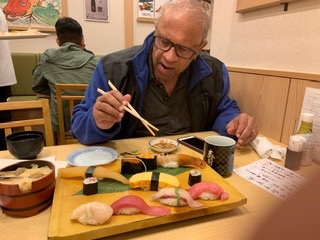
First, we have sushi – surely no trip to Japan can be complete without sushi. Now I am not a great fan of sushi – and neither is Mini – but what we had was surprisingly good. Mini and Lekshmi who was with us were not overly adventurous but I pretty much tried everything. There was one item – you can see it on the extreme left in the picture orangish/yellow that I took just one bite and gave up because it was tasteless and seemed like cartilage – crunch as well.
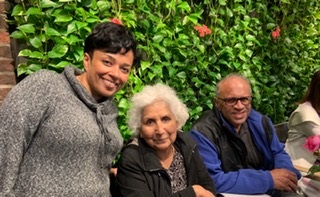
A visit to Japan is not complete without experiencing one of their tea rooms. This was a modified tea room – no sitting on the floor – but all they served was variety of different teas and a couple of pastry choices. I had a blend of Darjeeling and Ceylon and Mini and Lekshmi had more exotic stuff like mint tea, etc. It was a long wait to get a table – long lines seem common to get a table. The setting of the tea room was nice – surrounded by vegetation and flowers.
With the benefit of hindsight we should have spent about 4 days in Kyoto, made a day trip to Hiroshima and perhaps included a two day visit to Osaka which which was missing from our itinerary. As it worked out the itinerary we made in the US resulted in us spending only two days in Kyota which was really not sufficient to do justice to this magnificent city with its old world charm and lots to see.
Anyway we arrived here from Hiroshima on an unreserved train which involved changing at Osaka. We left booking a reserved seat until too late and by the time we tried reserved seats were fully booked because it was the end of Golden Week in Japan and there were a lot of people returning from their holidays – Golden Week is a major annual event in Japan made even more significant this year because it coincided with the abdication of the reigning emperor – the first abdication in over 200 years – and the coronation of his son the following day!

Hiroshima is worth visiting though it can be done in a day trip – we stayed here overnight but we could have spent the extra day in Kyoto instead.
There are two things worth seeing in Hiroshima, as a tourist – the Peace Museum which brings out vividly the trauma and tragedy of the first ever atom bomb that was dropped on a city as part of a war. There are two places that I have visited over the decades that I found profoundly moving: one was the Dachau concentration camp near Munich where tens of thousands of Jews were exterminated and the other was Hiroshima.
There are pictures of the devastation that resulted and remnants of what was left whether in the way of buildings or personal effect and in some cases actual personal effect like clothes, toys, etc. Then there were numerous pictures of some who were killed and/or disfigured. By the end of 1945 – the bomb was dropped in May of that year – approximately 140,000 people were killed either as a result of the bomb or the after effects. There were graphic images of people who drank what was described as “black rain” – they drank it because of sheer thirst – except they did not know that the rain was radioactive and it resulted in their deaths.
While we walked amidst the hundreds of others who were visiting the museum, a Japanese woman who looked to be in her late 30s’ or early 40s’ began to sob next to us. Mini instinctively placed her arm around her but could not say anything to her given that she did not speak English. Later as we were seated on a bench in the museum, this woman approached Mini and said something that we did not understand and then ended her conversation with one word of English: “welcome”.
Read the rest of this entry »Today was a rainy day but after being cooped up in the apartment through much of the morning, we decided to venture out even though there were occasional rain spells. We used the Tokyo Metro to go with Lekshmi and Brito to see the famous Shibuya Crossing – a remarkable experience by any definition.
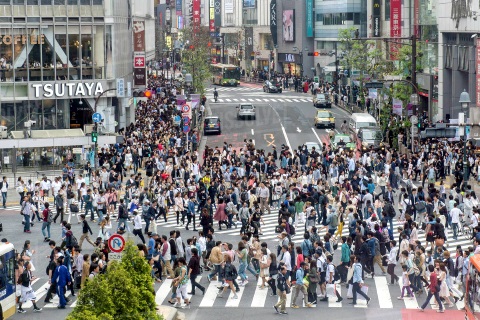
This is a famous crossing just outside Shibuya Station that is surrounded by shops and dining establishments. When the lights turn red at this busy junction, they all turn red at the same time in every direction – essentially crosswise and diagonally. Traffic stops completely and pedestrians surge into the intersection from all sides, in what seems like a chaotic scramble – pedestrians in the hundreds if not thousands scramble through the crossing in what is an extraordinary scene to witness . You can observe this moment of organized chaos from the second-story window of the Shibuya station – which is where we observed it. We observed it when the rain had ceased and also when it was raining and then we saw this sea of umbrellas crossing the intersection.
We then proceeded to the Imperal Palace where the Emperor and his family live. Again, our timing was not optimal because much of the Palace grounds were closed since on the day following our tour – April 30th 2019 – the Emperor was going to abdicate and for three days thereafter there were events involving the abdication and the coronation of the new Emperor. What we learned is that although the Japanese follow the Gregorian calendar, they also have “eras” that are given a name – and each era starts with the coronation of a new emperor. For example the era associated with Hirohito who was the emperor during the second world war was the “Showa” era, his son Akihito who is now abdicating had an era named “Heisei” and the era of the new emperor who is taking over – Emperor Naruhito – will have an era called “Reiwa”!
Given that access to the palace was limited, the images shown below are stock pictures from the internet.
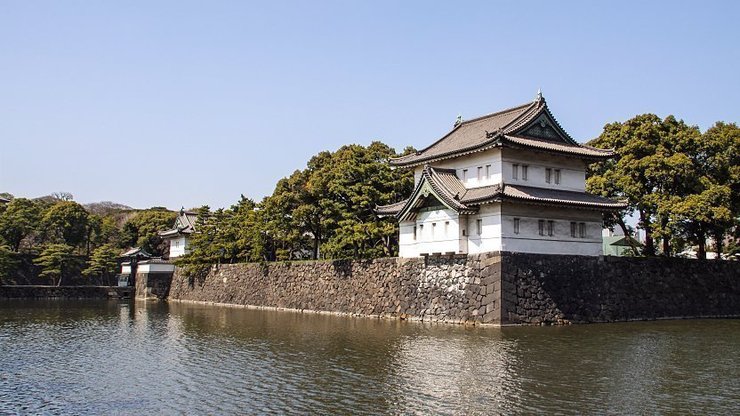

Nijubashi Bridge – within the palace grounds
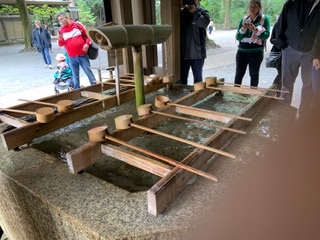
We spent much of Monday – the 29th – on a city tour seeing some of the major tourist spots. Among the places we saw was a Shinto shrine: Shintoism is the major religion of Japan. It is a faith that has no religious scripture or founder. It is a difficult religion to describe – they don’t believe in proselytizing which is why it is not found outside of Japan.
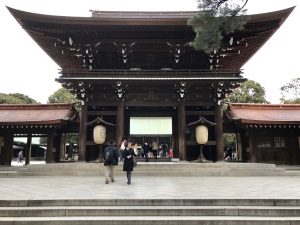
Meiji Jingu Shrine
Here is a link that explains Shintoism:
https://www.japan-guide.com/e/e2056.html

We went from the sake festival to a karaoke bar – karaoke is a big thing in Japan and there are facilities offering karaoke all over the city. We went to one not far from where Lekshmi lives with Karina – Lekshmi’s friend who bought the Christian Louboutin shoes. What happens is that one ends up renting a private room which was assigned for our use for an hour. The price we paid – about $75 – includes the use of the room and an alcoholic drink for the five of us.
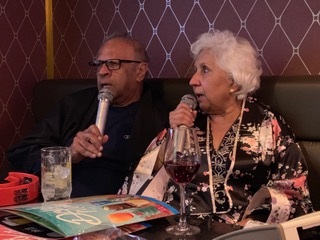
We select what songs we want to sing and then whoever wishes can join in the singing. Several of the songs that were selected were ones that I was not familiar with. Mini got into the act with Copocabana singing it with several of the others. Mini and I sang John Denver’s “Sunshine on my Shoulders” and I was the one who primarily sang Elvis Presley’s “It’s Now or Never”. Our selections of songs really dates us – especially my choice of the Elvis song. Such is the generation gap ………. because the others chose songs that were less ancient.
Following karaoke we went to dinner. The plan was to go to this local place that serves gyoza but that did not work out because when we got there, it had just closed. So we ended up eating tapas at a local haunt which was actually pretty good – even if it was somewhat expensive.
The previous day Lekshmi took us to a well regarded sushi restaurant. We had to wait for about an hour to get a table – which tells you how popular the place is – and the restaurant only serves sushi including run of the mill stuff as well as the more exotic choices. I have not been one for sushi – my one experience was at a restaurant in LA and it was not good – enough to turn me off for years. But being in Japan, I felt that I absolutely had to give it a try and I am glad that I did because the sushi was really quite good. I tried pretty much everything – the others were far less enterprising. We had ordered a platter with a variety of different items just to get a sample of the different items being served. There was one item that I gave up on very quickly – I don’t know what it was but it seemed like cartilage and was quite crunchy and tasteless!
We also went to a Japanese tea room in an unusual setting with lots of vegetation and flowers serving exotic types of tea. People wait for a long time for an opportunity to go through this experience. It is used as a setting for conversation while people imbibe tea. There are a couple of snacks that are served if one so wishes though the primary objective is just to drink tea and chat!
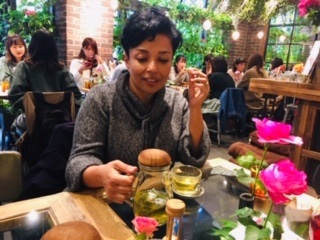
Dinner with tapas ended our fairly busy day …………….
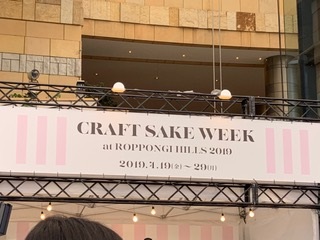
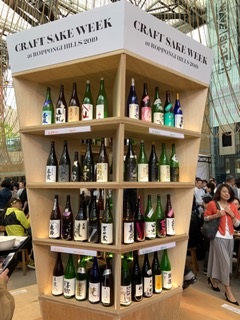
This was one of our major activities on Sunday – experiencing a wide variety of sake that was being served in the arena of a major shopping center nearby.
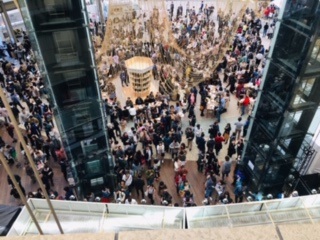
It resembled a huge food fair but the emphasis was on different types of sake though there were some “upscale” food trucks serving different types of cuisine ranging from Japanese to German and Italian. Interestingly we did not see any Chinese which is a staple at such events in the US. There was something akin to burgers and hot dogs that we avoided.
We have now been in Japan for three full days and I have to say that I am impressed with just about everything about the country – at least what I have seen and experienced.
The people are non –interfering and somewhat reserved – in part because of limitations with English – but they are respectful, helpful to the extent they can be and have a strong civic sense. The city – to the extent that we have seen it has to be one of the cleanest cities I have seen. Brito, the day we arrived, said the Japanese strive for perfection and he is right. As I mentioned previously, Tokyo reminds one of Manhattan where everyone walks and the use of cars is limited to the occasional use of taxis which are expensive. There is a heavy reliance on public transportation with the Metro and Japan rail both of which are super-efficient and extensive with frequent service – in the case of the metro, literally every two minutes or so and in the rush hour, every 30 seconds! The carriages are very clean unlike what limited experience we had in NYC – the stations are also very modern with everything automated.
It is rare to see an overweight, let alone and obese Japanese person and this applies to the young, middle aged and elderly. This is probably a combination of factors: the diet – they don’t seem to eat much in terms of portions, the diet seems to be focused on protein and less on carbs with a lot of seafood. The other factor is the level of activity – like in the case of Manhattan people seem to walk a great deal and driving is relatively uncommon. Finally, I am sure that genes play a part but when you consider that Asians who move to the West tend to be heavier, it would seem that diet and lifestyle are more important factors than genes.
Read the rest of this entry »Inspired by my brother Peter’s detailed narrative of his trip to the Holy Land, I decided to emulate his example and record our visit to Japan – our first time to this part of the world. As opposed to the daily account that Peter followed, I am going to record key highlights of our visit here which was from April 26th to May 8th when we will be returning to the USA.
We were fortunate in being able to stay with our niece Lekshmi and her husband Brito. Lekshmi who works for the US State Department has been posted to the US Embassy in Tokyo and been provided with an apartment in a complex that houses only embassy personnel. It has strong security – a sign of the times given that although Japan is a safe country and Tokyo is a safe city, ultimately US personnel presumably are always vulnerable pretty much anywhere in the world.
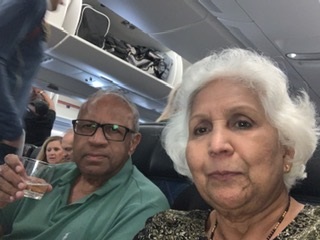
We left the US from Orlando airport on to Los Angeles from where we took our connection to Tokyo airport. We flew on Delta and opted for Premium Select which is something between Economy and Business Class. It gives one more leg room, free drinks and ostensibly better food though I can’t say that I was impressed with the food. But for a long flight – a total of almost 17 hours of flying time, the more comfortable seating was a plus.
Lekshmi and Brito met us at Haneda airport when we arrived and have been very hospitable hosts during our stay. Lekshmi works at the US State Department and has been on assignment with the US embassy in Tokyo. She has been provided with an apartment in a complex that is exclusively for embassy personnel.
Brito is an excellent cook and our first dinner here consisted of salmon, baked potato and various vegetables and was delicious – and, of course, wine and other alcoholic drinks.
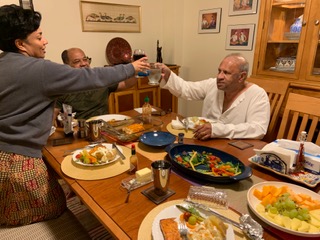
Fortunately, given that this is Golden Week in Japan and much of Japan, including the embassy personnel are off for the week so they have been able to spend more time with us. It has been an ideal set up for us as opposed to staying in a hotel with all of the constraints that one associates with a hotel.
Just by way of an aside, we elected to pay $5 each which enabled us to avail of unlimited roaming, texting and data during our stay in Japan through Sprint who is a carrier in the US. It turned out to be unnecessary because we have LTE service through Softbank just about everywhere in Tokyo – better service than we get in the US with Sprint! This is probably explained by the fact that SoftBank now has a 78% ownership interest in Sprint. So those with Sprint service in the US have the benefit of excellent service in Japan – and certainly in Tokyo.
We will be in Tokyo until the 4th and thereafter we head to Hiroshima and Kyoto and return to Tokyo on the 7th and catch our flight back to the US on the 8th.
Final Day in Cairo, return to Kochi & sundry thoughts on the trip
We were afforded the rare luxury of waking up at 8am, having a leisurely breakfast and then getting on the bus by 10am. By the time our luggage had been identified and loaded it was a bit after 10:30 in the morning and then got on the bus for our sightseeing experience before making the trip to Cairo International airport.
The last of our sightseeing trips conducted was a Coptic Church, St.Sergius and Bacchus which was built on what was believed to be the hideout of the holy family when they had to flee to Egypt from Israel. The bible mentions that with the impending birth of Christ, Herod the King was threatened by the prediction that a child would be born who would take over his kingdom and wear his crown. The gospel of Matthew states that Herod ordered that all male children under the age of 2 should be killed and sent his soldiers out carry out his command. Upon which Joseph, Mary and the infant Jesus fled to Egypt. There was a sycamore tree which is called the Tree of the Virgin, popular among the Coptic Christians. There was the well from which the holy family drank off, and the church with its unique icons and saints, all of them Coptic saints who were not familiar to me.
Cairo
After a good breakfast which was a choice of continental and Middle Eastern food we got on the bus with Mehmood our guide explaining that our first stop is what any person who has heard of the Great Pyramids of Giza would look forward to visit with much anticipation, which summed up the feelings of our tour group. The Pyramids were very close to Le Meridien and we were among what seemed like hundreds of tourists flocking to see one of the great ancient wonders of the world. We started with the biggest one which is called Khufu or Cheops (as the Greeks called it) and if one were to recall some of the dates of it being built 2600 years before the birth of Christ. This was during the Old Kingdom which Mehmood explained was when the 3 pyramids were built, Khufu, Khafre and Menkaure, the biggest one being Khufu. The dimensions of the stones and weight are all a matter of record, but what was apparent was that there was no visiting allowed to the inner chambers where the mummified remains, if any were kept. We were told that it was “under construction”. We walked around, taking photographs of the Pyramids and then were bussed to where the famous Sphinx is situated, at a distance the 3 pyramids were varying in their sizes, but a sight that would leave an impression on even a casual onlooker. The level of human effort and engineering that went into building these monuments and every angle we looked at these works of magnificence, knowing that each of these stones were hand crafted and hauled all the way to meticulously involving sophisticated design to what we see 5000 years later is as awesome a human feat of engineering as any I had seen.
Travel to Cairo/St Katherine Monastery/Suez Canal/Cairo
We were told that the bus journey from South Sinai to Cairo was going to be a long one, and to be on the bus by 8am. So we started on October 25th, the route was along the coastline of the Red Sea and the last part would be the Gulf of Suez. We would then cross the Canal through the tunnel to enter into Cairo. Our only stop on the way was to be a place which is commonly known to Christians as St.Katherine where there is a monastery and a church built centuries ago over the burning bush that Moses had seen, and was given the Ten Commandments. We had to be transported by taxis and vans to this church, ostensibly the reason was there was not enough of maneuvering room for a full size bus to drive up to the site more likely it could be that the localers were trying to make an extra buck by providing us the transportation to the site.
We did see a bush, purportedly from the seeds of the original bush, and the inevitable sales of rocks which surrounded the spot, again symbolic for the faithful. The significance of St.Katherine’s monastery is more historical than is common knowledge, and I am one of them who read up after the fact about it’s long history and the true nature of this UNESCO site. The books, parchments, palimpsests( ancient manuscripts which have been overwritten by scraping or washing off the original text) a treasure trove for religious historians as they house some of the oldest Christian manuscripts, second only to the ones in the Vatican.
After spending about two hours we were back again on the bus and were informed by our guide Mehmood that we were going to stop by a wayside restaurant. The food was quite basic, grilled chicken and a salad with some kind of yogurt mix with rice and the Egyptian flat bread. There is a realization when making trips such as these especially in foreign countries, that wayside restaurants are going to be basic and in many cases one has to bite the bullet vis-à-vis the standard of food offered.
Read the rest of this entry »Transit to Egypt/Red Sea/Tabha
Of the 10 days we were on the Holy Land trip, this day was one of the less productive ones as far as sightseeing was concerned. We were supposed to have been taken to the House of Bethany, home of the two women who took Christ in to their house and the famous recounting of Martha washing Christ’s feet after anointing it with expensive and sacred oil. This however had to be cancelled due to local strife between the Israeli authority and Palestinians, from what was recounted to us there was stone throwing and tear gas to dispel unruly crowds. Unfortunately this happened on the route to Bethany. We also parted ways with our guide in Israel Shehadi, who had been friendly and informed, but one could feel that he needed more exposure in the business, he had only 1 ½ years of experience and that was evident at times.
The border checking was rigorous, from Israel to Egypt, South Sinai. We changed buses again, luggage, immigration formalities et al. Due to Egypt’s heavy security, we had accompanying us right through our trip in Egypt a government appointed security guard on the bus, a new driver (whose name escapes me) and our Egyptian guide – Mehmood. He introduced himself as from Luxor, and we found him to be over the next 2 plus days, articulate and very knowledgeable of both Egyptian history and Christian lore. I discovered that he had a masters degree from the University of Cairo in Egyptology. Mehmood, gave us an idea of what was going to be the historical leg of our tour, we were going to see the Great Pyramids, Sphynx and visit a Museum in Cairo. One of the stops on our long 10 hour journey to Cairo was the Qumran caves where in the middle of the last century the Dead Sea scrolls were discovered that gave further historical basis to the life of Christ and on the whole Judeo-Christianity faiths. The caves themselves could not be described as deep into the earth, but the fact that the Scrolls were found there was in some ways quite remarkable after what must have been more than 18 or 19 centuries.
Read the rest of this entry »Mount of Olives/Church of the Ascension/River Jordan/Dead Sea
At the crack of dawn we were up at the hotel that we were put up, not due to any time constraints as it was in the previous days but because we wanted to explore a bit of the Palestinian side, and with Shyni’s friend and coworker mentioning that she was from Ramallah we had limited time to step out and try to get the feel of the city. As any traveller can attest, to step into just one neighborhood in any city especially in a foreign country is not really a taste of what daily living is, it was a cool morning my friend and co-traveller Joy and I stepped out for a quick stroll. From our vantage point the most conspicuous buildings were the domed ones, which in this part of the world typically would mean a mosque and it looked like the city was dotted with them. Despite the hour the streets were busy with fair amount of traffic. After breakfast the six of us were bussed to the hotel where the rest of the group had stayed. There were a lot of dissatisfied faces as they got on to the bus. The hotel they stayed in was not up to par. We heard the linen, sheets, towels, food, none of which seemed to have been to our group’s satisfaction. I have to admit we were lucky in that we spent the night in a hotel which was good, not so much for the 40 others who stayed on there. After the customary prayers & singing in the bus, we were taken to our first destination, the Mount of Olives. The journey there was a very steep climb into the heart of Jerusalem, we saw the controversial West Bank wall that Israel had put in a lot of time, money and effort to build in what they perceived as necessary in stopping radicalized or disgruntled Muslims from entering their city. There had been a spate of terror incidents, in the years preceding the building of the wall, and even after when tunnels were found from the Palestinian side. The graffiti and the images of destroyed buildings will remain as a memory of that bus ride and it reminded me of a quote which comes to mind, of how intolerance exists among people :
Welcome to Planet Earth
Where children who do not know how to live
teach their children how to live
We reached the Mount of Olives, the chapel of the Ascension, the spot where Christ is believed to have gathered the disciples and ascended to heaven, there is slab of stone where his footprint is contained. Several of the group, among them Shyni, prayed with articles of faith, rosaries, crosses, other items of clothing or trinkets.
Read the rest of this entry »Church of the Holy Sepulchre/Tomb of David/Last Supper/Western Wall
As each day passed it became routine for us to start out early, as our two guides Bindu & Shehadi urged us to do so, after an early breakfast, usually by 6 or 6:30 in the morning. On this day in particular, we had a full itinerary starting with the Church of the Holy Sepulchre. As we combed our way through the old city of Jerusalem, with Shehadi explaining about the various quarters in the path of the Via Dolorosa (the way of suffering) where Jesus walked carrying the cross to the site of his crucifixion. One remembers that this is the holiest of the holy for Christians, the very reason that Christianity came about. We walked through the Old City via narrow lanes, shops lined up on both sides the bulk of them were with religious memorabilia, but there were a few with spices and one in particular specialized in olives of various varieties, it was a reminder how much olives were part of the food that people who live in these countries consumed. If memory serves me right, we started at the Armenian quarter, moved through the Jewish quarter and the Church of the Holy Sepulchre is located in the Christian quarter and yet is governed by the Palestinian authority, at least there was a sign to indicate that . Each of the stations of the cross are numbered and one comes across the various times when in Christ’s path to the crucifixion, he fell – there is a church of flagellation, the name evokes the suffering that Jesus had to endure and is venerated by Christianity. We finally reached the courtyard leading to the Church of the Holy Sepulchre and the lines have started to form, so we are right at the back, little did we realize this was going to be a very long wait, in fact when reviewing some of the photos taken it appears to be that we started waiting at the courtyard around 9am and by the time we reached the Rock of the Calvary, the spot where Christ’s tomb is believed to be, encased in glass the sanctum sanctorum of Christianity, it was 2pm.
Read the rest of this entry »Cana/Bethlehem/Church of the Nativity
We started our day after breakfast early as usual, on the bus the morning prayers and devotional songs were sung and chanted. Our trip for the day according to the schedule sent out to us was going to be first to Shepherd’s Field – as the name suggests it is where the shepherds “watched their flocks by night” when the birth of Jesus occurred. Many of the songs, Christmas carols, passages from the bible and our memories are closely associated with these illusory figures, the shepherds. It was a short walk from where the bus was parked and we managed to see what must have been a field, but now has become urbanized with all the trappings of buildings except for a plot of land which was supposed to mark the spot the shepherds saw the star. The next stop, walking distance was the church of the Ascension – built and rebuilt over the centuries, dating from the time of Helena the mother of Constantine. It currently is in Muslim jurisdiction as Shehadi explained, but is given religious significance because Jesus is considered a prophet in Islam. We also visited the church of the Immaculate Conception which supposedly is where Mary found out from the angel Gabriel of her virgin pregnancy.
Once we all got on the bus, the next stop was going to be a special one – the site of the first miracle performed by Christ – the one at Cana where water was turned into wine. There is now a Greek Orthodox church built at the site, it being a Sunday there was a service going on and when our group, among others barged in, we were told to leave until the service was over. An irate priest strode out after sometime and raised his voice with “Ela Ela” from what I later on gathered he was telling us to leave or “cut it out” until he allows us back in – so we got out of the church compound and were further instructed that only by noon would we be allowed back in, a wait of 1 ½ hours. To my mind, even if there was reason to the priest’s ire, it could have been handled better, and I lost any desire in entering the church after that unceremonious eviction, but this is where the groupthink comes into play and from what we were told there was no way we could return to Cana and several in the group wanted to get in the church. The logistics in getting back in after our next stop the Church of Nativity, per Bindu was such not only because of the distance and time it would take us it would be impractical, and so I waited in the bus. From what I gathered from Shyni and the folks who did visit the church in Cana, the renewal of the marriage vows is always a joyful gesture quite apart from the spirituality of visiting the famous site.
Read the rest of this entry »Amman to Israel
Again, an early start to our day after breakfast. Once settled in the bus, morning prayers songs were sung – our bus took us from Jordan to Israel and we started going through what would become routine on our travel security checkpoints, this one was at the Jordanian border into Israel. A TSA type of scan of all our luggage and our papers were scrutinized, with some questions thrown in to ensure that we were all part of the group. At this point we changed buses and guides, Talal the experienced guide was replaced by a younger man by the name of Shehadi a Palestinian who would be our guide for the next 3 days.
Once all the immigration formalities, luggage and change of buses was completed we started our bus journey to Capernaum, with the sea of Galilee in sight. Our new guide Shehadi’s explanation was inaudible, partly due to his quieter voice and an accent that would take a bit to get used to, making us strain our ears to hear him. However he was well versed in the history of the various sites we were about to visit, explaining in detail the landmarks such as Mt.Tabor. We would skip visiting that mountain as it would require an arduous climb which Royal Omania and Bindu had decided was not a climb that most of our group were equal to since from Bindu’s description it would take the same amount of time to return which would be a total of 8 hours, once we reached the summit.
Mt.Tabor has a special place in Judaism & the Old Testament, where supposedly the blessing of Moses took place as explained by Shehadi, who is a Palestinian Christian. From there we were on our way to Capernaum the significance of which was unknown to me but from what I have gathered is that Jesus used this town as his base for preaching in Galilee and one of his miraculous healing episodes was here that of the cure of Simon Peter’s mother-in-law. The White Synagogue, named for standing out against the rest of the landscape in it’s imported white sandstone. The point which is emphasized later on in the bible is that Jesus was a Jew who, albeit preached a different word, but would often make his presence and more important his words, considered heretical to the Jewish Orthodoxy in that synagogue and in the temple of Jerusalem. Capernaum is referred to by Mark as Jesus “own city”.
Amman, Jordan
Our day started out early, we had been forewarned by Bindu that this will be the trend for most of the days, the idea being to keep to the itinerary with some of the places that we need to visit being far apart. After breakfast, which was opened by 6 or 6:30 am at the hotel restaurant, again, the menu would be repeated throughout the trip, with slight variations. There would be a choice of eggs, bread, fruit, maybe even some meat such as chicken or beef in the form of sandwich slices or sausages, of course never any pork. We were in a Muslim country and later on in Israel too, the Jews consider pork as unclean. By 7 or 7:30 am we all got on the bus to start our first trip that would take us an hour plus before we reached Madaba to a Greek Orthodox church, St.George’s. We were introduced to our Jordanian guide, Talal who looked to be in his middle age – when later I had an opportunity to talk to him, he impressed me that in spite of being a Muslim he was knowledgeable about Christianity and its origins, being a tour guide for over 17 years he had all his facts well researched. During the bus ride we were encouraged to join in the morning prayer and song which was led by our good friends John Isaac & Mini – their wealth of knowledge in prayer and song especially, Orthodox(Malankara) can rarely be matched. We came to realize that we had by default two prayer leaders. We reached Madaba, the church but in fact the whole town is famous for its mosaics and what was special about that church was the map, made out of mosaics depicting the entire Holy Land and ancient Palestine with all the biblical sites – this particular piece is dated as far back as 5th century after Christ. Christianity had spread to the Roman empire, Egypt, Byzantine and beyond, even to India according to several traditions within Kerala Christians. Christianity is one of the first, like Judaism where people have been documenting and archiving it’s spread. It is the religion of the book and is revealing of it’s global reach, that it had spread as far as India, not too long after it’s inception. When we had all gathered on the bus, Bindu posed the question as to whether we wanted to have lunch before embarking on our next stop, the consensus was to proceed to the next stop which was Mecharus. Again on our journey there were prayers and song, this meant a lot to creating a mood of piety for some especially on such a trip where the goal was akin to a pilgrimage.
Arriving at Mecharus, the site of ruins of a fortress of Herod evoked feelings of the ancient with the sight of the hills. Access was via a steep path to the actual ruins of the fortress where John the Baptist was beheaded, and where Salome did her famous dance, made even more famous by writers in later times who called it the “Dance of the Seven Veils”. A few of us decided to climb to the top of that hill, a steep climb aided by roughly hewn steps, at an elevation of 1500 feet or 500 meters, or so the sign said. At the top were a few ruins of the columns where the fortress stood and if you looked around surrounded by hills of sandstone and rock with no vegetation, just native shrubs and bushes. This lack of greenery is something that we would get used to while traveling through the 4 countries that constituted the Holy land tour.
Read the rest of this entry »Introduction by Rana:
In 2013, we went on a pilgrimage to the Holy Land and I included several posts on our trip. Since then I have told quite a few people – mostly Indian Christians – that it was one of the more fulfilling trips that we have undertaken.
My brother, Peter (Eapen Joseph Panicker) went with his wife, Shiny, and several others and used the same tour operator that we did – Royal Omania Tours in Kochi. He kept a journal of his trip to the Holy Land and he recently shared it with family and friends. He did a far better job than I did in recording the different facets of the pilgrimage. He gave me permission to publish the relevant excerpts from their journey.
What follows over the next several posts is a day by day account of Peter’s journey.
************************************************************************
Kochi to Amman, Jordan
The tour officially started on an early Thursday morning at Nedumbassery Airport. Outside the airport to meet us was Bindu, a young woman with a friendly and ready smile, and who for the next 10 days will be our tour guide.
Soon she was joined by others in our group who stood in the front of the airport with varying sizes of luggage, some of them had already donned what looked like red caps. There must have been at least 30 of us who had gathered, Bindu was there to make sure that the head count matched what she had on her sheet and then handed us the first of the Royal Omania giveaways, a shoulder bag and a red cap emblazoned with the Royal Omania tour logo. This cap was later on described by our daughters as our MAGA (make America great again!) look alike caps. As we filed into the airport Bindu took charge of getting us situated, the air travel to and fro from the Holy Land countries had been handled by her tour agency
Our flight from Kochi to Amman was on an Emirates Airlines with a stopover in Dubai. For those of us who do the round trip to India from the US subjected to those long hours of travel time, this 4 hour plus journey was a quick one arriving in Dubai around noon local time. It’s at Dubai that we were joined by the rest of our group from the US, and adding them our group had swelled to 48 people. Two hours later we were on the next Emirates flight from Dubai to Jordan which was even a shorter flight 3 1/2 hours to Amman – Queen Alia airport. All travel formalities were handled by the capable Bindu. When the formalities were completed our motley group, friendly and seemingly happy to have each others company got on the bus, which for the next two days would take us around Amman and as we learned later, the same bus would transport us all the way to the Israeli border. After the luggage was loaded we went straight to the hotel. Initially it did not strike me that a lot of the public transportation especially tourist buses, were Mercedes Benz. The seating was quite comfortable with a decent amount of legroom. The buses are equipped with a speaker system and above all driven by competent drivers in the countries we visited – Jordan, Israel, Palestine & Egypt.
Read the rest of this entry »The image which appears below was contributed by Roxanne Loget and is a tribute to her best friend, Marianne Ambrey, who was a trainee flight attendant with Pan Am and was killed in the crash of Pan Am Flight 217.
The main write up regarding that crash and those who lost their lives appears on this link.
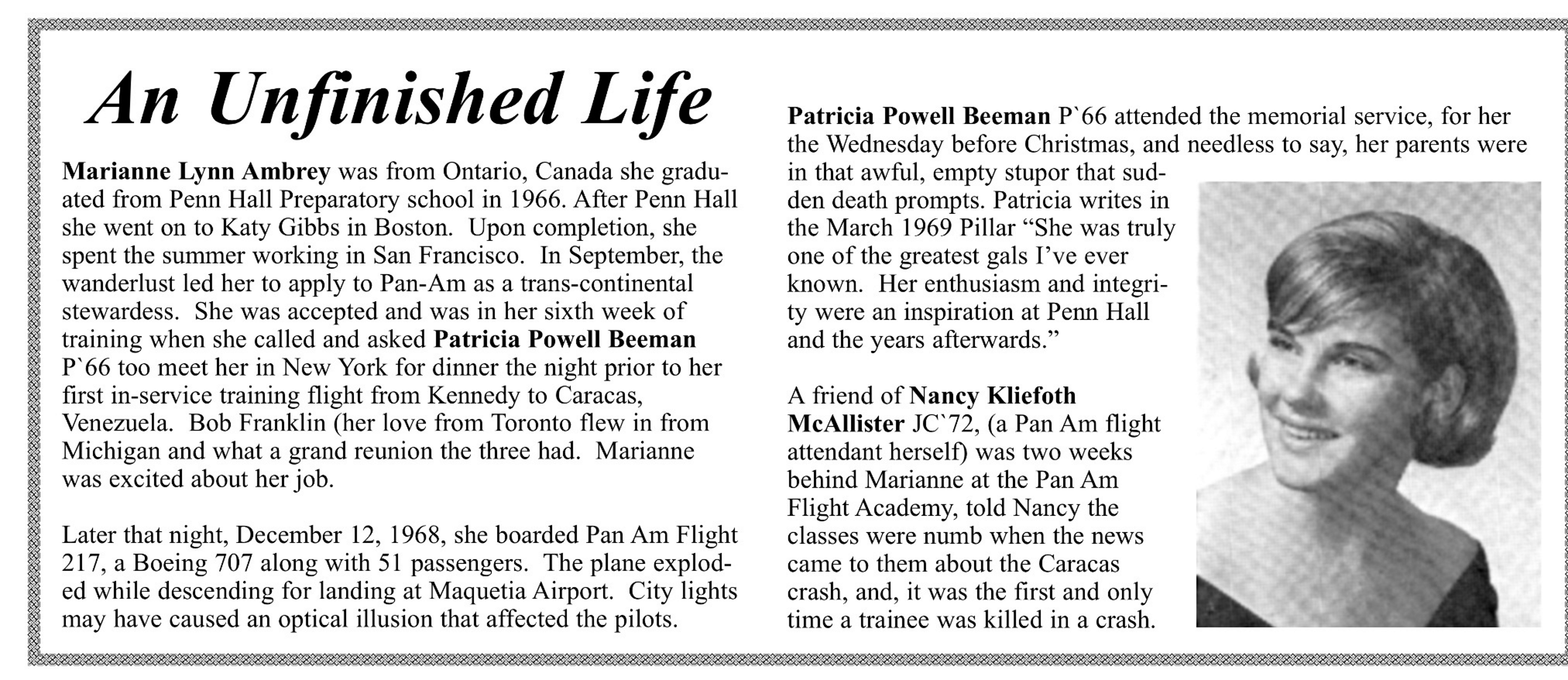
I am also adding Roxanne’s comment from last year when she shared some memories and thoughts about Marianne:
“I will forever remember the first time we met In August 1967 or 68. I had JUST moved in…or maybe SHE had just moved in… to a shared room in The Lodge, a Victorian mansion turned into a boarding house at the corner of Sutter & Lombard in San Francisco (still there). It was a Sunday night, about 10 p.m. when all of a sudden, a whirlwind of fun blew into the room, flopped down on MY bed & declared: “Ohhhhhhhh. I had the most diVINE weekend. i fell in love….THREE times!” and we were instant BFs.
Read the rest of this entry »
From Nazareth we traveled to Cana where Jesus performed his first miracle and turned water into wine at a wedding where the hosts had run short on wine. According to John 2:1-11:
“On the third day there was a wedding in Cana of Galilee, and the mother of Jesus was there. Jesus and his disciples had also been invited to the wedding. When the wine gave out, the mother of Jesus said to him, “They have no wine.”
And Jesus said to her, “Woman, what concern is that to you and to me? My hour has not yet come.”
His mother said to the servants, “Do whatever he tells you.” Now standing there were six stone water jars for the Jewish rites of purification, each holding twenty or thirty gallons. Jesus said to them, “Fill the jars with water.” And they filled them up to the brim. He said to them, “Now draw some out, and take it to the chief steward.” So they took it.
When the steward tasted the water that had become wine, and did not know where it came from (though the servants who had drawn the water knew), the steward called the bridegroom and said to him, “Everyone serves the good wine first, and then the inferior wine after the guests have become drunk. But you have kept the good wine until now.” Jesus did this, the first of his signs, in Cana of Galilee, and revealed his glory; and his disciples believed in him.”
As is the case with other sites associated with Jesus there are two conflicting versions of where this occurred. We went to the one that is traditionally associated with the event – Kafr Cana – where a small Franciscan church has been erected.
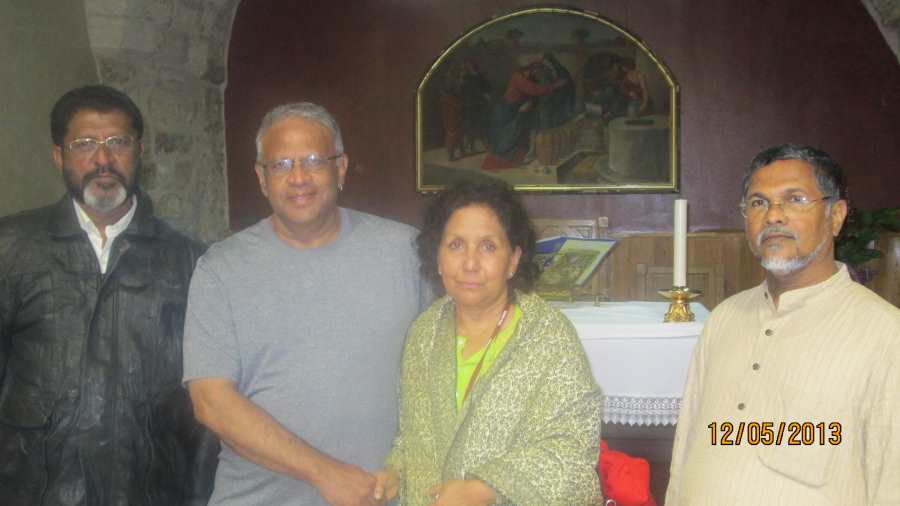
Since the miracle associated with turning water into wine occurred during a wedding feast, Achen offered all members of the group an opportunity to renew their marriage vows at this church. A brief service was conducted by the two Achens, and some of the married couples renewed their vows. Mini and I did so as well and the picture below shows us with the Achens – back wearing their street garb – after the ceremony. During the ceremony, we were told to hold hands – I was situated to Mini’s right and as I held her right hand with my left one, an Achen hastily asked me to hold her hand with my right hand – similar to what you see in the picture.
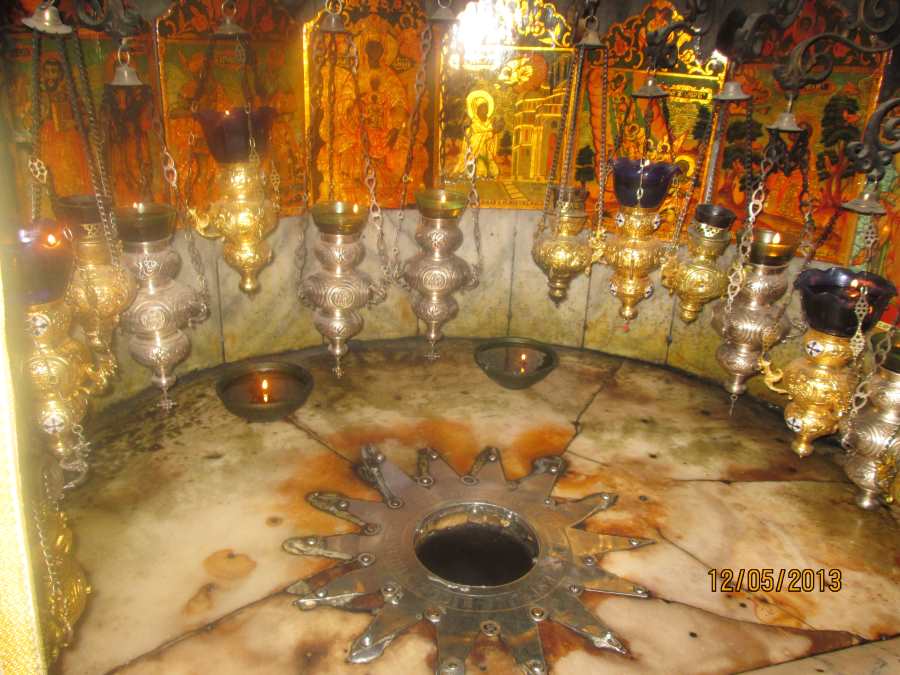
After Cana we went to Bethlehem – an area controlled by the Palestinians – to visit the Church of the Nativity built in the location where it is believed that Jesus Christ was born. Interestingly there are no other sites identified with the birth of Jesus and this location is one of the holiest ones for Christians. For my part, it was certainly one of the more emotional moments of the tour of the holy sites. Just about everyone in the group prostated themselves at the site where Jesus was believed to be born – marked with a 14 sided star.
.
Read the rest of this entry »
From the Sea of Galilee we proceeded to Tabgha to the Church of St Peter’s primacy.
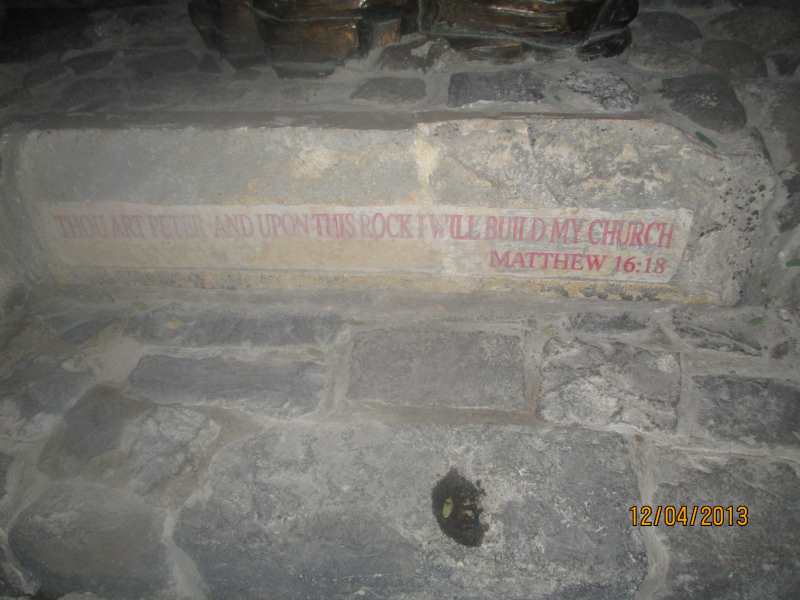
In John 21, Jesus appears to his disciples for the third time after his resurrection on the shores of the Sea of Galilee. The night before, Peter and several other disciples had sailed out on the lake to fish, but caught nothing. In the morning, a man appeared on the shore and called out to them to throw their net on the right side of the boat. Doing so, they caught so many fish they couldn’t drag the net back into the boat.
At this point Peter recognizes Jesus, and promptly jumps out of the boat to wade to shore to meet him. The other disciples follow in the boat, dragging the net behind them. When they land, Jesus and the disciples have fish and bread together. This is believed to have taken place on the Mensa Christi, a large rock incorporated in the chapel. Like the early church built in the 4th century – the walls of which are still visible on three sides – the modern chapel incorporates a large portion of the stone “table of Christ” (Latin: Mensa Christi) at the altar. This is where Jesus is believed to have served his disciples a fish breakfast after they landed on shore

After breakfast, Jesus reinstated Peter (after his three-time denial of Jesus at the crucifixion) with the words “Feed my sheep”. This is the event for which the modern church is named, which is interpreted by the Catholic Church to give the Pope (as the successor of Peter) authority over the worldwide Church.
One thing to keep in mind when visiting the Holy Land is that some of the sites most important to Christians are based on tradition as to their location in the context of the life of Jesus Christ. Occasionally, there are differing opinions as to the correct location of a particular site. One such example of these differing opinions is where Jesus was baptized.
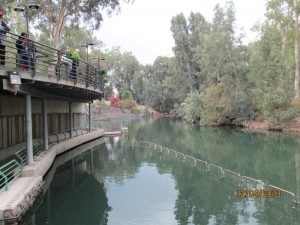
We visited Yardenit that is viewed by some as the approximate location where Christ was baptized. There is an alternative location closer to the Dead Sea and there is no consensus as to which location is the right one. Frankly, it did not bother me. What we do know is that the gospel according to Mark says:
“And it came to pass in those days, that Jesus came from Nazareth of Galilee, and was baptized of John in Jordan.
And straightway coming up out of the water, he saw the heavens opened, and the Spirit like a dove descending upon him: and there came a voice from heaven, saying, “Thou art my beloved Son, in whom I am well pleased.”

Yardenit is a beautiful, serene location through which the Jordan flows into the the Sea of Galilee and given that many come to visit this site it is well maintained. Yes, there is an element of commercialization which one finds in most of the major biblical sites but it really did not bother me. I just ignored that aspect and focused more on what the site was intended to convey. There are facilities to be baptized again if one so wishes. In the case of our group most went down the steps and dipped one’s hands in the water.
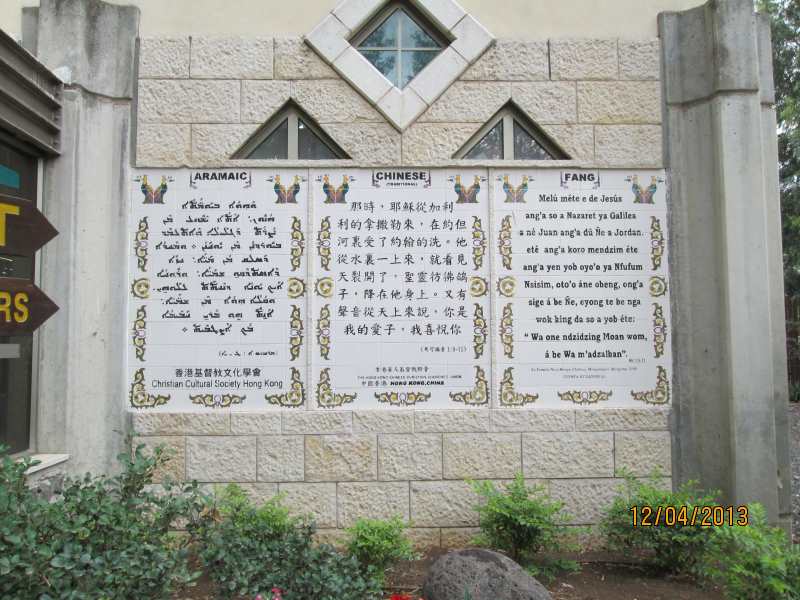
On the walls surrounding the site at Yardenit there are numerous inscriptions as to the significance of the site in many languages from around the world – including some languages that I had never heard of! It is an indication of the number of visitors from all over the world who come to this site.

We stayed one night at the Amman Airport Hotel and left the next morning by bus for Israel driving through downtown Amman just in order that we get a glimpse of the capital since the previous day we were on the outskirts of Amman while visiting Madaba and Mount Nebo. We had wanted to visit Petra – which is not part of the itinerary of this tour but we were willing to pay the extra amount involved just so that we could see it given that we were within three hours of Petra while in Amman. Unfortunately there were logistical issues in doing so and therefore it will have to wait for another day.
The bus drove us to within a few yards of the Israeli border with Jordan. We were cautioned not to take any pictures at the border.
The much vaunted Israeli security was in effect as we arrived at the border. While we sat in the bus, Israeli security used instruments to scan the bus for any threats – presumably bombs – checking out the underneath of the bus as well as the wheels, etc. There were armed security personnel everywhere carrying AK47s’ or equivalent semi-automatics.
Read the rest of this entry »
We flew from Cochin to Amman, Jordan.
There was nothing remarkable or striking about Amman. It is essentially desert – probably akin to areas like Los Angeles and Las Vegas many decades ago before development occurred and sources of water were either found or redirected to those cities.
Jordan is primarily Muslim but Christians live peacefully with Muslims and there is no tension between the groups – they socialize, work together and are respectful of the respective traditions and beliefs of the other group. Jordan also has a tradition of receiving refugees from other parts of the Middle East at times of upheaval in those regions. In the 70s’ there were refugees from the West Bank after the ‘67 Arab-Israel war. In subsequent years there have been refugees from Iraq, Lebanon, Egypt and more recently from Syria. It has imposed tremendous strains on the social fabric as well as the economy of Jordan in the process. Most of the refugees are housed in tents and although the UN, the US and some other countries offer aid to help with the refugee problem the brunt of the cost is still borne by Jordan both financially as well as in its impact on the Jordanian people.
Our Jordanian guide had moved there from Dearborn, Michigan two years earlier because his aging parents needed help

Our Jordanian guide with his family
The topography is interesting in that buildings in Amman are on multiple levels as there are a lot of hills – barren of any vegetation for the most part – but houses and apartments have been built at different levels with some having panoramic views of the city. The buildings make for a sea of white or off white because they are all constructed with Jordanian limestone.
Jordan is basically a poor country with little in the way of resources and there is a marked disparity between the rich and poor who make up the bulk of the population. Unlike other Arab countries that have oil, Jordan does not have any oil or any other natural resources. According to the guide much of the real estate in Amman is owned by approximately 150 families. The rest of the population rents from these families who are their landlords.
Read the rest of this entry »
Recent Comments